
Cetaceans of the Mediterranean Sea
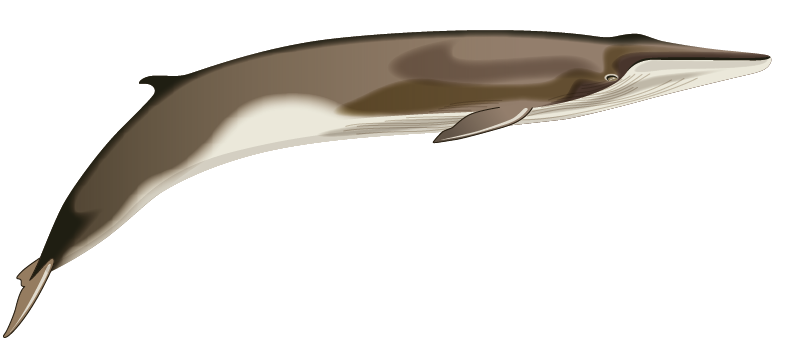
• IUCN Red List of Threatened Species (Mediterranean population): Endangered
The fin whale is particularly threatened by collisions with ships and motor yachts and by the effects of climate change.
- Length at birth approx. 6 m
- Birth weight: approx. 2 t
- Maximum length: 27 m
- Maximum weight: 80 t
The fin whale is a large baleen cetacean. Despite its impressive size, this species has an extraordinarily streamlined structure, with a triangular and flattened head. Its back is lead-grey in colour, while the belly is light. A distinctive feature is the asymmetrical coloration of its lower jaw: dark grey on the left and white on the right. The dorsal fin is relatively small but prominent, positioned toward the back. The female is slightly larger than the male.
It gives birth to a single calf, after a gestation period of approximately 11–12 months. Lactation lasts about 6 months.
The fin whale inhabits all the world's oceans and prefers the pelagic environment, though it sometimes approaches the coast, becoming visible from shore. Its primary diet consists of krill and small fish.
The social behaviour of the fin whale is still little known. It is often sighted as a solitary individual but can also be seen in pairs or small groups of 3–4 animals. However, group size may not be an accurate measure of the species' sociability, as these cetaceans can keep in contact over long distances through their low-frequency "moans." Toward humans, they typically exhibit rather shy behaviour.
The fin whale is the most frequent mysticete in the Mediterranean Sea and its sighting is not an unusual event, especially in the north-western basin.

• IUCN Red List of Threatened Species (Mediterranean population): Endangered
The sperm whale is particularly threatened by bycatch, collisions with ships and motor yachts and the effects of climate change.
- Length at birth: approx. 4 m
- Birth weight: approx. 700 kg
- Maximum length of male: 18.5 m (exceptionally 21 m)
- Maximum weight of male: 57 t
- Maximum length of female: 12.5 m
- Maximum weight of female: 24 t
The sperm whale is the largest of the odontocete cetaceans. Its build is extraordinarily robust, with the huge head taking up almost a third of its entire length. Colouration is grey-brown, uniform over the whole body. Occasionally there are whitish spots around the jaw and on the belly. The dorsal fin is low and triangular and precedes a series of irregular gibbosities, of variable number. The male is much larger than the female.
It gives birth to only one calf, after about 15 months of gestation. Lactation lasts at least two years but can extend well beyond weaning (up to 7-10 years).
The sperm whale lives in all the oceans of the world and prefers the pelagic environment where it feeds mainly on cephalopods but also on medium-large fish.
In the open ocean, the sperm whale exhibits complex social behaviour, with male groups joining females during the breeding season. In the Mediterranean Sea, they are usually sighted as solitary individuals or in small groups (no more than 5–6 animals). However, it is known that these animals can maintain acoustic contact over considerable distances. Toward humans, they typically display rather shy behaviour.
The sperm whale is relatively common in the Mediterranean Sea, especially in the western basin, but it is not easy to sight because it spends most of its time underwater. This species can dive up to 3000 metres deep, with apneas lasting up to 2 hours. However, it is possible to detect the presence of these cetaceans by listening for their acoustic signals, similar to hammer blows. It is the only cetacean in the Mediterranean that regularly emerges with its tail before each dive.
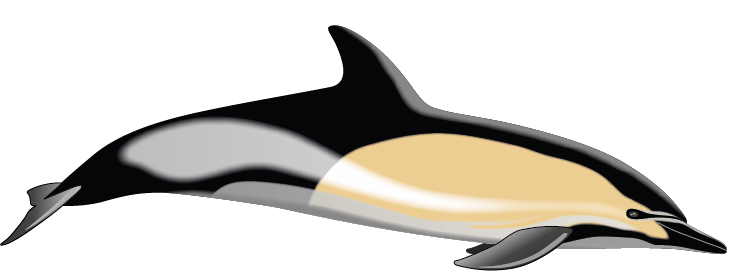
• IUCN Red List of Threatened Species (Mediterranean population): Endangered
The common dolphin is particularly threatened by bycatch, habitat transformation and degradation, and the effects of climate change.
- Length at birth: approx. 0.9 m
- Birth weight: approx. 10 kg
- Maximum length: 2.6 m
- PesoMaximum weight: 100 kg
The common dolphin is a delphinid of modest size, slender build, long and thin beak. The coloration is dark grey on the back and white on the belly. A distinctive feature is the hourglass pattern on the side, with a clearly visible dark V in the centre of the body, under the dorsal fin. In the anterior portion the hourglass takes on ochre tones (although this coloration is visible especially out of the water). The dorsal fin often has a light shade in the centre. The male is slightly larger than the female.
It gives birth to a single calf, after about 11 months of gestation, and lactation lasts about 2 years.
The common dolphin lives in tropical and temperate waters worldwide and can be sighted in both pelagic and nearshore habitats, where it feeds on fish and cephalopods. It is a social species and forms large groups, often composed of 100 or more individuals (exceptionally up to thousands of units). It has a lively and curious behavior and willingly approaches boats to swim in the bow wave.
Once common in the Mediterranean Sea, the common dolphin suffered a rapid decline during the 20th century, for reasons that are still unclear. Today it is usually sighted in small groups, often in association with the striped dolphin. However, it remains a regularly occurring species in the Alboran Sea and in some regions of the eastern basin.
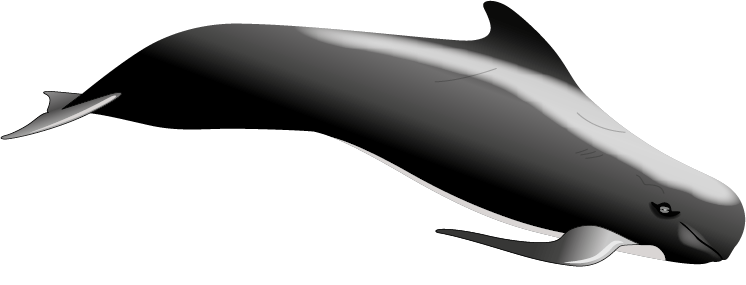
• IUCN Red List of Threatened Species (Mediterranean population): Endangered
The pilot whale is especially threatened by bycatch and the effects of climate change.
- Length at birth: approx. 1.7 m
- Birth weight: approx. 90 kg
- Maximum length of male: 7.5 m
- Maximum weight of male: 2 t
- Maximum length of female: 5.5 m
- Maximum weight of female: 1 t
The pilot whale is a large delphinid, with a globular head and inconspicuous rostrum. The colouration is typically ebony black, with a whitish anchor-shaped pattern on the chest. The dorsal fin is low and wide, with a rounded apex. The male reaches a much larger size than the female.
It gives birth to a single calf, after about 15 months of gestation, and lactation lasts about 3 years.
The long-finned pilot whale lives in the temperate and cold waters of the southern hemisphere, on the edge of the polar circle, and in the North Atlantic. It prefers the pelagic environment, at the deep edge of the continental slope, where it feeds primarily on cephalopods and secondarily on fish.
It is a social species and forms medium to large groups (up to hundreds of individuals). The pilot whale is usually not afraid of boats and often approaches them curiously, lingering around the hull. Sometimes it also shows curiosity and confidence towards people in the water, but its imposing size and unpredictable nature make such close contacts imprudent.
In the Mediterranean Sea its presence is limited to specific areas of the western basin: the Alboran Sea and the north-western Mediterranean, including the Pelagos Sanctuary.
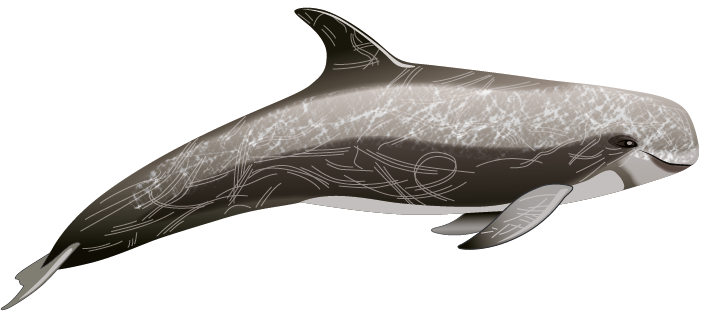
• IUCN Red List of Threatened Species (Mediterranean population): Endangered
The Risso's dolphin is particularly threatened by bycatch, habitat transformation and the effects of climate change.
- Length at birth: approx. 1.5 m
- Birth weight: unknown
- Maximum length: 4.3 m
- Maximum weight: 600 kg
The Risso's dolphin is a robust-bodied delphinid, with a rounded head and an inconspicuous rostrum.
Its coloration is peculiar and appears grey, of variable shade, in young individuals, marbled in adults. A distinctive feature is the depigmented scars that mainly furrow the anterior dorsal area of the body and make the head of adult individuals almost white.
It gives birth to a single calf, after about 12 months of gestation, and lactation lasts about 3 years.
The Risso’s dolphin lives in all the world's oceans, except polar and subpolar waters, and seems to prefer continental shelf habitats, between 200 and 2000 metres deep. It feeds mainly on cephalopods and secondarily on fish.
It is a social species that forms medium-sized groups of 15-20 individuals. It usually shows little interest in boats and only occasionally allows close approaches or swims along the bow wave.
In the Mediterranean Sea, it is observed mainly in the western basin, with a patchy distribution. However, sightings of Risso's dolphins have declined in recent decades, and the conservation status of this species is a concern among researchers.
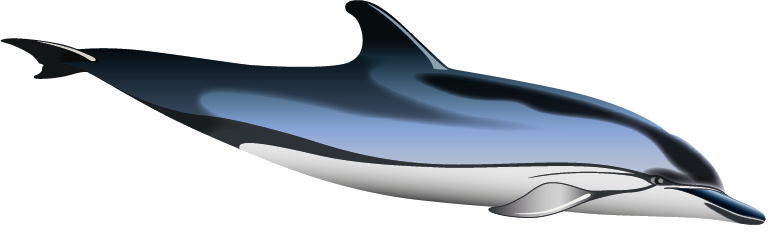
• IUCN Red List of Threatened Species (Mediterranean population): Least Concern
The striped dolphin is particularly threatened by bycatch, habitat transformation and the effects of climate change.
- Length at birth: approx. 0.9 m
- Birth weight: approx. 10 kg
- Maximum length: : 2.6 m
- Maximum weight: 150 kg
The striped dolphin is a small, streamlined dolphin with a prominent beak. Its coloration is slate grey on the back and white on the belly, with a light brushstroke running up the side toward the dorsal fin. A distinctive dark stripe also runs from the eye along the side of the body.
It gives birth to a single calf, after approximately 12 months of gestation, and lactation lasts about two years.
The striped dolphin inhabits all the world's oceans, except for polar and subpolar waters, and prefers the pelagic environment. Its diet includes fish and cephalopods.
It is a highly social species and forms medium to large groups (even hundreds of individuals). It has a lively and curious behaviour and often approaches boats to swim in the bow wave.
In the Mediterranean Sea, it is one of the most common species and the most frequently sighted in pelagic environment.
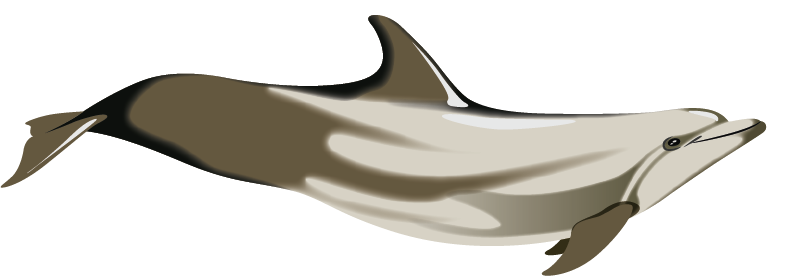
• IUCN Red List of Threatened Species (Mediterranean population): Least Concern
The bottlenose dolphin is particularly threatened by habitat modification and degradation, caused by anthropisation of the coasts, and by the effects of climate change. However, the remarkable behavioural plasticity has allowed this species to survive in fair numbers to the present day.
- Length at birth: approx. 1 m
- Birth weight: approx. 12 kg
- Maximum length: 4 m
- Maximum weight: 350 kg
The common bottlenose dolphin is a delphinid with a robust build, a stubby but conspicuous rostrum, a pearl-grey, shaded colouration, darker on the back, almost white on the belly. The male is slightly larger than the female.
It gives birth to a single calf, after about 12 months of gestation, and lactation lasts about 3 years.
The common bottlenose dolphin lives in all the world's oceans, except for polar and subpolar waters. It prefers the continental shelf habitats (within 200 metres depth), but in some regions two distinct ecotypes are recognised, one coastal and one pelagic.
It is known for its plastic behaviour, which allows this dolphin to adapt to a changing environment. It also easily learns to exploit fishing gear, such as gillnets or trawls. These skills are passed down from one generation to the next as a local culture. It feeds on fish and cephalopods.
It is a social species and forms small to medium-sized groups (6-12 individuals), but sometimes larger aggregations can be sighted (up to 50 or more individuals).
Its behaviour towards boats varies: in some areas it is shy and wary, while in others it is curious and confident, often approaching boats to swim in the bow wave. It happens exceptionally that solitary individuals spontaneously establish relationship of trust with humans.
In the Mediterranean Sea it is one of the most common species and the most frequently sighted in the continental shelf waters.
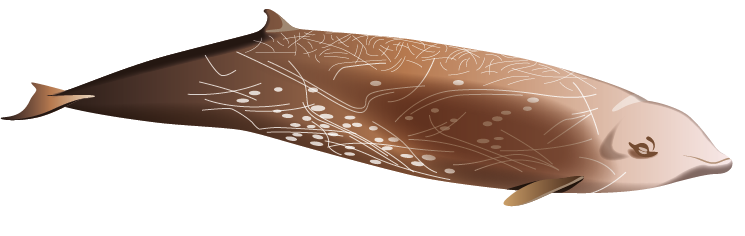
• IUCN Red List of Threatened Species (Mediterranean population): Vulnerable
The Cuvier’s beaked whale is especially threatened by bycatch and the effects of climate change.
- Length at birth: approx. 2.5 m
- Birth weight: unknown
- Maximum length: 8 m
- Maximum weight: 6 t (on average approx. 3 t)
The Cuvier's beaked whale is a medium-large odontocete cetacean, belonging to the Ziphiidae family. Its body is robust, with a rather small head and a visible but short rostrum. The colouration of the back is grey-brown, sometimes with bluish tones, fading towards the head which appears whitish in adult individuals. The dorsal fin is characteristic, small and very far back.
Like all cetaceans it gives birth to only one young at a time, but data on gestation and lactation are incomplete.
It lives in all the world's oceans except polar waters, but its distribution and abundance is poorly known. It is a typically pelagic species that seems to prefer the habitat of submarine canyons. It feeds primarily on cephalopods and secondarily on fish.
It is usually sighted in pairs or in small groups, rarely consisting of more than 5-6 individuals
The sighting of the Cuvier's beaked whale is rather rare, likely due to its frequent and prolonged dives; this species can reach a depth of 2000 meters, holding its breath for over 30 minutes. However, increased research efforts have led to a considerable rise in sightings.
It has a rather shy behaviour, but sometimes approaches boats showing a certain degree of confidence.
In the Mediterranean Sea it can be sighted in both basins, with a patchy distribution and some areas of regular presence, such as the Alboran Sea and the Pelagos Sanctuary (north-western Mediterranean).